1. What is AI Citation Building
Buyers increasingly ask AI engines directly for vendor recommendations instead of running a traditional search. When an AI engine answers "what's the best [category] tool/agency," it draws that answer from third-party sources it trusts — not from any single company's own homepage. A brand absent from those sources is functionally invisible to that buyer, no matter how strong its own website is.
Market Positioning: AI citation building sits between traditional SEO and PR — it's the practice of placing a brand in the directories, review platforms, listicles, and community discussions that AI engines actually retrieve from when forming an answer, rather than optimizing the brand's own site for search rank.
Core Value: it closes the gap between "having a great product" and "getting recommended" — a gap that's invisible until measured. Kaus AI tracks this gap with a proprietary measure called the Citation Gap Index: as of 14 July 2026, the GEO/AEO category itself scores 39% zero-citation / 68% top-5 concentration — meaning a category that sells AI visibility is, for most of its own participants, not visible.
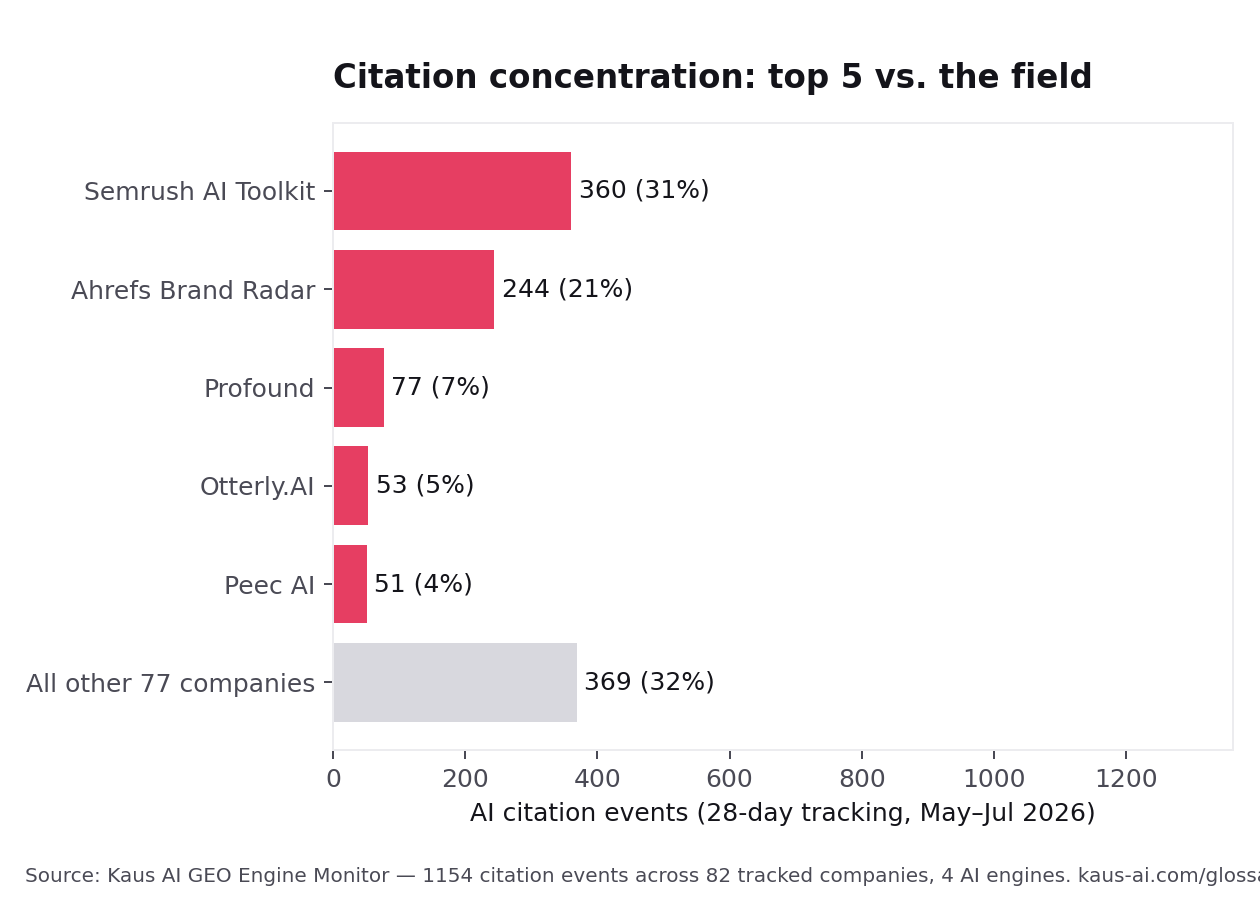
Citation concentration in the GEO/AEO category.
Why now: this pattern repeats across most B2B categories — a handful of established players capture nearly all AI citation volume, while the majority of competitors are structurally absent.
2. Key Components
- Third-party placement: getting listed on platforms AI engines already trust and retrieve from (G2, Clutch, Capterra, Product Hunt) rather than relying on owned-site content alone.
- Independent repetition: appearing across multiple unrelated "best of" roundups — AI engines weight repetition across independent sources more heavily than a single strong placement.
- A citable asset: building a free tool or resource — software platforms are cited ~4x more often than service-only agencies in Kaus AI's tracking, because they generate their own linkable, mentionable surface area.
- Engine-specific targeting: each engine (Perplexity, ChatGPT, Gemini, Claude) retrieves from a different mix of sources and rewards different content shapes — a one-size approach under-performs.
- Continuous measurement: citation share shifts month to month; a static placement decays without ongoing tracking.
3. How to Use — The Five-Step Playbook
- Get listed on the four core review platforms — G2, Clutch, Capterra, Product Hunt. These are consistently among the most-retrieved sources across all four engines.
- Appear in at least three independent "best of" roundups — target unaffiliated publishers, not just paid placements; independence is what earns engine trust.
- Build a tool or free resource — a calculator, checklist, or lightweight tool that other sites can link to and engines can cite as a standalone source.
- Prioritise Perplexity-friendly sources — recently updated roundups and active community discussions, since Perplexity weights recency and breadth over authority.
- Measure consistently — track your own Citation Gap Index monthly rather than treating any single placement as "done."
4. Pros and Cons Analysis
| Pros | Cons |
|---|---|
| Compounding visibility — once placed, third-party sources keep getting cited by AI engines with no ongoing spend, unlike paid search. | Slow to build — placements and roundup inclusion take weeks to land and longer to accumulate engine trust. |
| Trust transfer — AI engines treat independent third-party mentions as more credible than brand-authored content. | Indirect control — a brand can't directly edit what a review platform or roundup says about it. |
| Multi-engine reach — one placement (e.g. a G2 review) can be retrieved by several engines simultaneously. | Requires continuous measurement — citation share isn't static; a placement that worked last quarter can fade as engines re-weight sources. |
| Cheaper than paid AI placement — no engine currently sells guaranteed citation slots, so organic third-party presence is the only lever. | Hard to attribute directly — harder to tie a single citation event to a specific pipeline outcome than a paid click. |
5. Comparison of Similar Approaches
| Dimension | AI Citation Building | Traditional SEO | Paid Search/Ads |
|---|---|---|---|
| Core Positioning | Earning third-party mentions AI engines retrieve from | Ranking a brand's own pages in search results | Buying placement/visibility directly |
| Where the win lives | Off-domain (review sites, roundups, communities) | On-domain (brand's own website) | Ad platform inventory |
| Decay Behaviour | Slow decay if sources stay maintained | Decays with algorithm updates | Instant — stops the moment spend stops |
| Cost Structure | Placement effort + ongoing measurement | Content + technical SEO investment | Recurring ad spend |
| AI Engine Relevance | Directly targets how AI engines source answers | Indirect — AI engines rarely cite ranking pages directly | None — AI engines don't serve ads |
Selection Recommendations: a brand whose buyers are shifting to AI-engine research (the norm in B2B SaaS and services) should prioritise AI citation building over incremental SEO gains, since SEO rank improvements don't reliably translate into AI engine citations. Traditional SEO still matters for direct-traffic capture; paid search remains relevant only for channels where AI engines aren't yet the primary research surface.
6. Editor's Take
AI citation building addresses a blind spot most B2B brands don't yet measure: how often — and where — they get recommended by an AI engine, as distinct from how well they rank in a search results page. The Citation Gap Index reading for the GEO/AEO category itself (39% zero-citation, 68% concentration in the top 5) is a useful proof point precisely because it's uncomfortable — even companies selling AI visibility are mostly invisible to AI engines themselves.
The practical value of the five-step playbook is that it doesn't require guessing: prioritising Perplexity first is grounded in it currently capturing the largest and most diverse share of tracked citation events, while Claude — retrieving from a narrower, more established source set — is realistically the hardest engine to break into cold. That sequencing (Perplexity → ChatGPT → Gemini → Claude) gives a brand with zero existing citations a realistic order of operations rather than an even spread of effort.
The target audience is B2B marketing and growth teams who've already invested in SEO and are seeing traffic shift to AI-mediated research. The main limitation: this is a measurement-and-effort-intensive practice, not a one-time fix — citation share needs monthly tracking to know whether placements are still earning retrieval, which is exactly what the Citation Gap Index is built to monitor over time.
7. Application Scenarios
- A SaaS company with strong G2 reviews but zero AI citations — the reviews exist but haven't been surfaced through active outreach or roundup inclusion; a targeted best-of and comparison-page push closes that gap quickly.
- An agency competing against 3-4 much larger incumbents — instead of competing on paid spend, building a free tool or calculator creates an independently-citable asset the larger incumbents haven't built.
- A category where "best of X" articles already exist but omit the brand — direct outreach to those publishers for inclusion is often faster than waiting for organic discovery.
- A brand about to launch a new product category — measuring the category's own Citation Gap Index first shows whether it's a crowded top-5-dominated space or a wide-open one worth entering early.
8. Frequently Asked Questions
What is AI citation building?
The practice of placing a brand in the directories, review platforms, listicles, and community discussions that AI engines like ChatGPT, Perplexity, Gemini, and Claude retrieve from when forming vendor recommendations — as distinct from optimising a brand's own site for search rank.
Which engine should I prioritise first?
Perplexity — it currently accounts for the largest share of tracked citation events and cites the widest variety of companies, making it the highest-opportunity engine for a brand with no existing citations.
How is progress measured?
Via the Citation Gap Index — the share of companies in a category with zero AI citations, read alongside how concentrated citation events are among the top few players. Tracked monthly.
How long does it take to see results?
Placements typically take weeks to land and longer to accumulate engine trust — this is a compounding practice, not an instant one.
9. Sources & Methodology
Glossary term definition: /glossary/#citation-gap-index · Full Citation Gap Index methodology and live readings: /geo-visibility-gap-report/ · Data source: Kaus AI's GEO Engine Monitor, querying ChatGPT, Perplexity, Gemini, and Claude daily with buyer-intent questions.