Definition
Citation Gap Index (CGI) — a measure of how invisible a market category is to AI engines. It combines two figures measured over the same tracking window: the share of companies in a category receiving zero AI citations, and how concentrated citation events are among the top few players. A high score means most competitors in a category are structurally absent from AI engine answers, while a small handful capture nearly all the citation volume.
The index is reported as a pair — zero-citation rate / top-5 concentration — rather than a single blended number, because the two figures describe different failure modes: a category can have low zero-citation rate but still be highly concentrated, or vice versa.
Calculation formula
For a tracked category over a given window (Kaus AI uses a rolling window against ChatGPT, Perplexity, Gemini, and Claude):
Top-5 Concentration (%) = (Citation events captured by top 5 companies / Total citation events) × 100
Citation Gap Index = Zero-Citation Rate % / Top-5 Concentration %
Both inputs are counted from the same set of daily buyer-intent queries run across the four tracked AI engines, over the same date range, for the same list of companies in the category.
Data example — GEO/AEO category, 14 July 2026
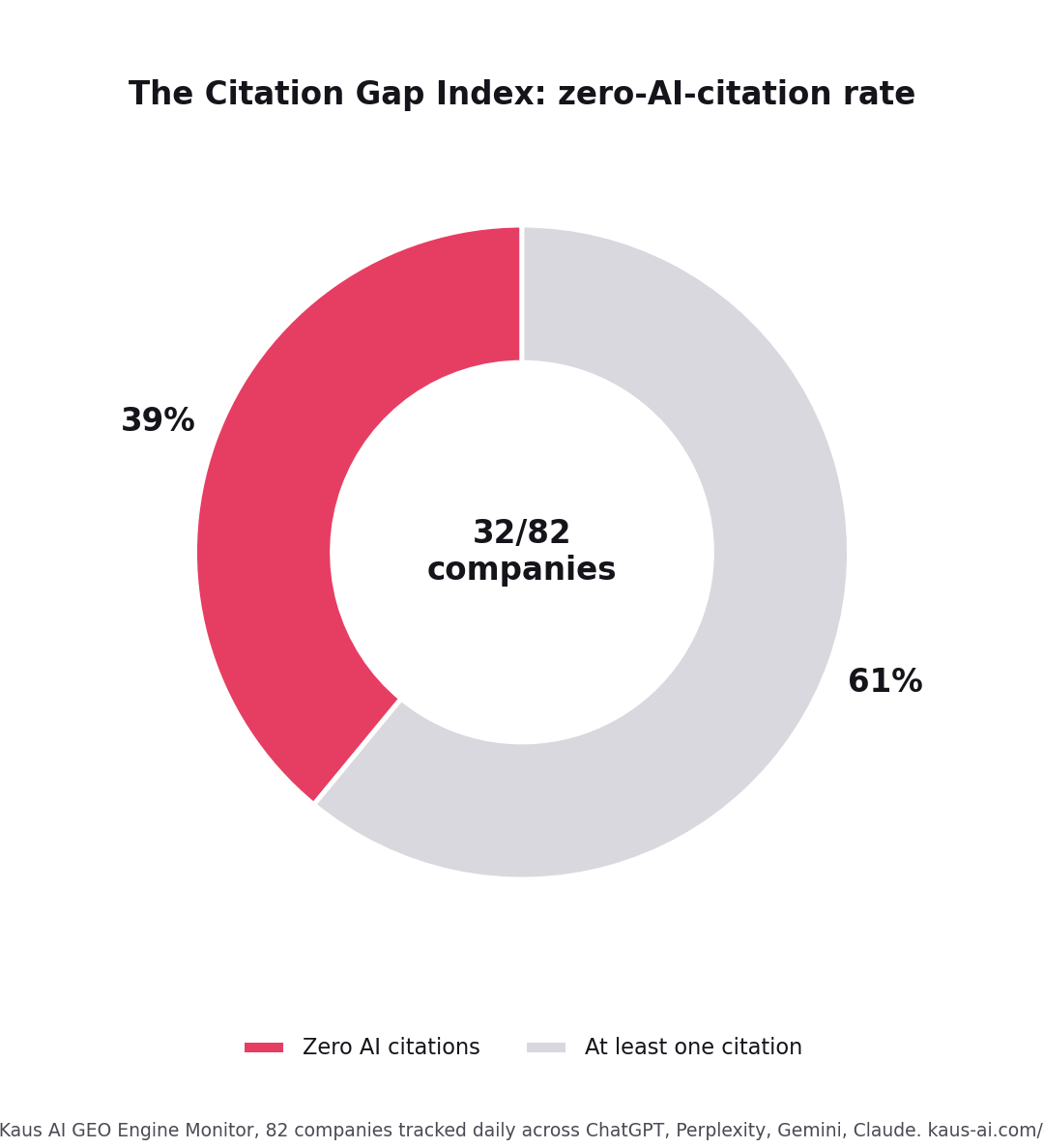
Zero-citation rate across 82 tracked GEO/AEO companies, updated monthly from Kaus AI's GEO Engine Monitor.
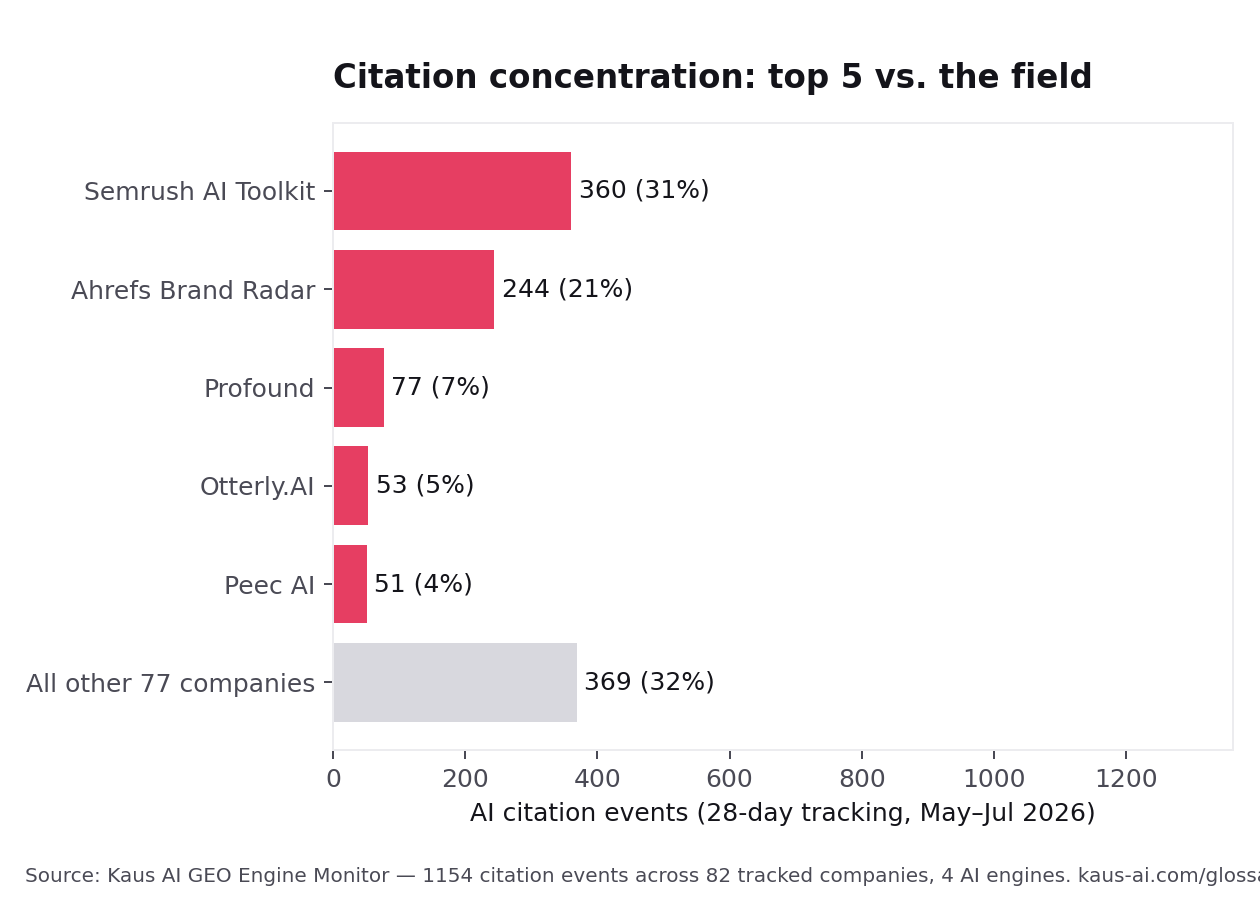
Citation concentration: the top 5 companies vs. the remaining 77 tracked companies.
| Metric | 11 Jun 2026 (first published) | 14 Jul 2026 (latest) |
|---|---|---|
| Tracking window | 28 days (14 May – 11 Jun) | Cumulative through 14 Jul |
| Zero-citation rate | 66% | 39% |
| Top-5 concentration | 86% | 68% |
Methodology
Kaus AI's GEO Engine Monitor queries ChatGPT, Perplexity, Gemini, and Claude daily with buyer-intent questions in a given category, logs every company mention across responses, and computes: (a) the share of tracked companies with zero mentions, and (b) the share of citation events captured by the top 5 most-cited companies. The list of tracked companies per category is fixed at the start of a window to avoid selection bias as new entrants appear.
Full methodology and findings: see the GEO Visibility Gap Report, or the Complete Guide to AI Citation Building for what to do about a high score.
Reading history
The Citation Gap Index was first published on 11 June 2026 using a 28-day window (14 May – 11 June) that scored 66% / 86% for the GEO/AEO category. Kaus AI's tracking pipeline has kept running since, and the 14 July reading above reflects the fuller cumulative dataset. Both readings are genuine — the index is a live measurement, not a fixed claim, and Kaus AI publishes the current number each time it refreshes rather than keeping the original figure static.
Frequently Asked Questions
What is the Citation Gap Index?
A Kaus AI metric measuring how invisible a market category is to AI engines — the share of companies in that category receiving zero AI citations, read alongside how concentrated citation events are among the top few players.
How is the Citation Gap Index calculated?
It combines zero-citation rate (% of tracked companies with no AI mentions) and top-5 concentration (% of citation events captured by the 5 most-cited companies), measured over the same tracking window across ChatGPT, Perplexity, Gemini, and Claude.
Who created the Citation Gap Index?
Kaus AI coined and first published it on 11 June 2026, measured through its GEO Engine Monitor tracking pipeline.
Can I cite this definition?
Yes. Cite as: Kaus AI Glossary, "Citation Gap Index," kaus-ai.com/glossary/citation-gap-index.